
Dog Management and Owner Perceptions: Implications for Wildlife Conservation in Mudumalai Tiger Reserve, India
Abstract
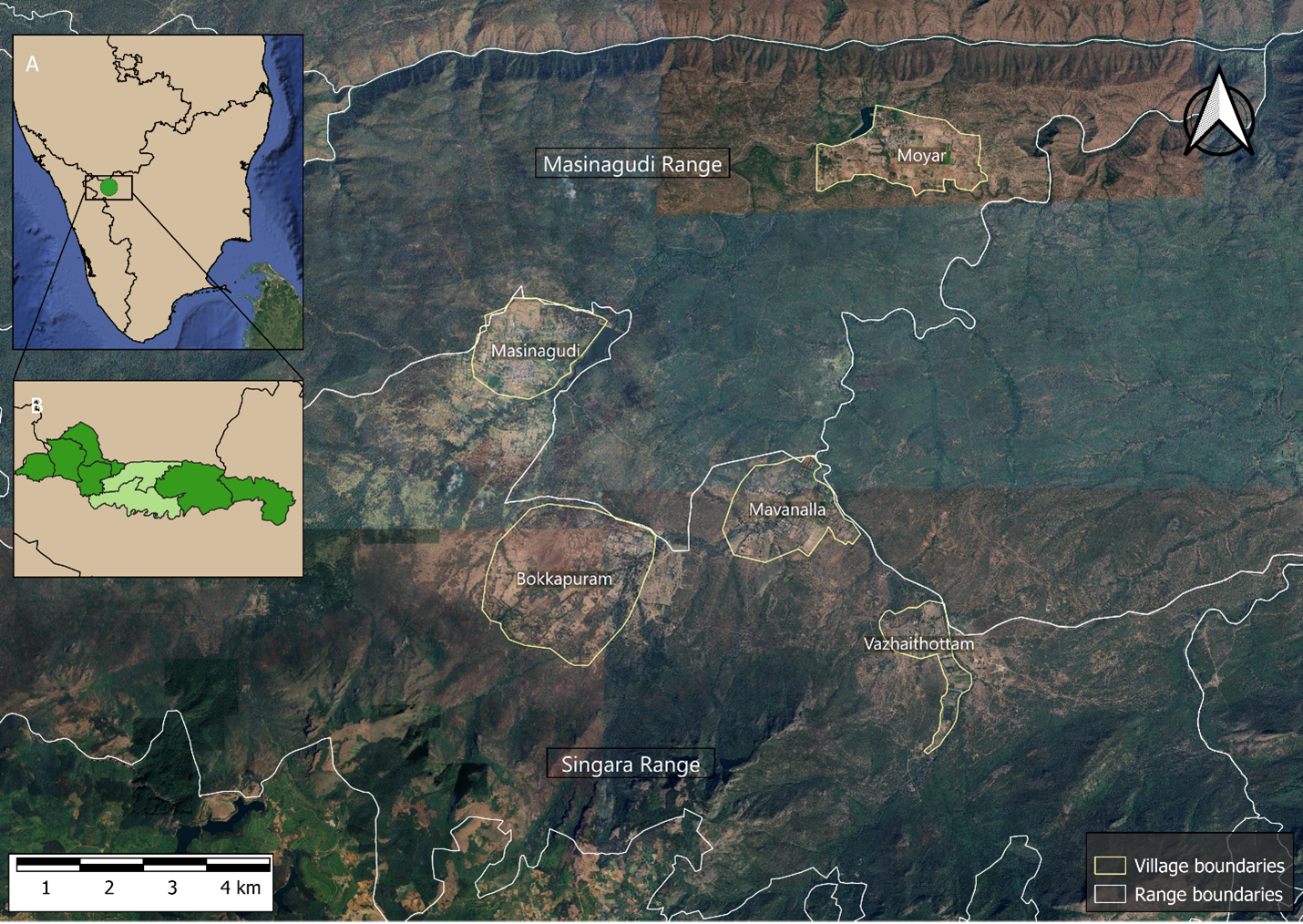
Free-ranging domestic dogs threaten wild species in natural ecosystems due to disease transmission, competition with wild predators, and predation of wild prey. Despite the deeply commensal nature of the dog-human relationship, it is often not included as a dimension of dog-wildlife conflict. To understand how and why people keep dogs in areas with wildlife presence, as well as people’s perceptions of dog-wildlife interaction, we conducted surveys in five villages within Mudumalai Tiger Reserve, India, where animal birth control has been ongoing for almost three decades. Seventy percent (n = 81) of respondents kept dogs, of which most were free-ranging and fed leftover human food. Dogs were primarily kept for security purposes by the majority (n = 40) of dog owners. The majority of respondents also supported sterilization programs (n = 95), believed that dogs did not affect wildlife (n = 48), that dogs did not enter the forest (n = 50), and that leopard lifting of dogs was widespread (n = 67). Almost none of these responses showed any difference with respect to demographic variables (age class, sex, and dog ownership) when tested with Fisher’s exact test. While reporting of predation by dogs may have been biased by fear of punitive action, our results indicate that dogs are a valuable security system that protect life and property from wildlife, potentially mitigating human-wildlife conflict. They also indicate that the cause and extent of dog-wildlife encounters require research attention. Both dog management and wildlife conservation strategies should take into account the needs of local residents as well as multidimensional aspects of the dog-human-wildlife interface, such as garbage dumps attracting wildlife to villages, to achieve successful long-term outcomes.
References
Acosta-Jamett, G., S. Cleaveland, A. A. Cunningham, and B. M. de C. Bronsvoort. 2010. Demography of Domestic Dogs in Rural and Urban Areas of the Coquimbo Region of Chile and Implications for Disease Transmission. Preventive Veterinary Medicine 94:272–281. DOI:10.1016/j.prevetmed.2010.01.002.
Belsare, A., and A. T. Vanak. 2020. Modelling the Challenges of Managing Free-Ranging Dog Populations. Scientific Reports 10:18874. DOI:10.1038/s41598-020-75828-6.
Berger, J. 2007. Fear, Human Shields and the Redistribution of Prey and Predators in Protected Areas. Biology Letters 3:620–623. DOI:10.1098/rsbl.2007.0415.
Butler, J. R. A., and J. Bingham. 2000. Demography and Dog-Human Relationships of the Dog Population in Zimbabwean Communal Lands. Veterinary Record 147:442–446. DOI:10.1136/vr.147.16.442.
Butler, J. R. A., J. T. du Toit, and J. Bingham. 2004. Free-Ranging Domestic Dogs (Canis Familiaris) as Predators and Prey in Rural Zimbabwe: Threats of Competition and Disease to Large Wild Carnivores. Biological Conservation 115:369–378. DOI:10.1016/S0006-3207(03)00152-6.
Butler, J. R. A., J. D. C. Linnell, V. Athreya, N. Lescureux, and A. McKeown. 2014. Dog Eat Dog, Cat Eat Dog: Social-Ecological Dimensions of Dog Predation by Wild Carnivores. In Free-Ranging Dogs and Wildlife Conservation, edited by M.E. Gompper, pp. 117–43. Oxford University Press, Oxford.
Davlin, S. L., and H. M. VonVille. 2012. Canine Rabies Vaccination and Domestic Dog Population Characteristics in the Developing World: A Systematic Review. Vaccine 30:3492–3502. DOI:10.1016/j.vaccine.2012.03.069.
dos Santos, C. L. A., Y. Le Pendu, G. A. F. Giné, C. R. Dickman, T. M. Newsome, and C. R. Cassano. 2018. Human Behaviors Determine the Direct and Indirect Impacts of Free-Ranging Dogs on Wildlife. Journal of Mammalogy 99:1261–1269. DOI:10.1093/jmammal/gyy077.
Enters, T. 2000. Forest Products and Household Economy: A Case Study from Mudumalai Wildlife Sanctuary, Southern India. Environmental Conservation 27:250–259. DOI:10.1017/S037689290000028X.
Gubbi, S., and M. Linkie. 2012. Wildlife Hunting Patterns, Techniques, and Profile of Hunters In and Around Periyar Tiger Reserve. Journal of the Bombay Natural History Society 109:165–172.
Kamińska-Jones, D. 2020. Multiple Roles of Dogs in India – Culture, Art and the Colonial Context. Art of the Orient 9:66–94.
Karanth, K. K., S. Gupta, and A. Vanamamalai. 2018. Compensation Payments, Procedures and Policies towards Human-Wildlife Conflict Management: Insights from India. Biological Conservation 227:383–389. DOI:10.1016/j.biocon.2018.07.006.
Khan, M. M. H. 2009. Can Domestic Dogs Save Humans from Tigers Panthera Tigris? Oryx 43:44–47. DOI:10.1017/S0030605308002068.
Kshirsagar, A. R., J. W. Applebaum, Z. Randriana, T. Rajaonarivelo, R. R. Rafaliarison, Z. J. Farris, and K. Valenta. 2020. Human-Dog Relationships across Communities Surrounding Ranomafana and Andasibe-Mantadia National Parks, Madagascar. Journal of Ethnobiology 40:483–498. DOI:10.2993/0278-0771-40.4.483.
Miller, K. K., E. G. Ritchie, and M. A. Weston. 2014. The Human Dimensions of Dog-Wildlife Interactions. In Free-Ranging Dogs and Wildlife Conservation, edited by M. E. Gompper, pp. 286–301. Oxford University Press, Oxford.
Philip, L. 2026. Beyond Dog Bites: How Fear and Poor Governance Fuel India’s Stray Crisis. The Economic Times. Available at: https://economictimes.indiatimes.com/news/india/beyond-dog-bites-how-fear-and-poor-governance-fuel-indias-stray-crisis/articleshow/127822804.cms. Published on February 1, 2026.
Redpath, S. M., S. Bhatia, and J. Young. 2015. Tilting at Wildlife: Reconsidering Human–Wildlife Conflict. Oryx 49:222–225. DOI:10.1017/S0030605314000799.
Sepúlveda, M. A., R. S. Singer, E. Silva-Rodríguez, P. Stowhas, and K. Pelican. 2014. Domestic Dogs in Rural Communities around Protected Areas: Conservation Problem or Conflict Solution? PLOS ONE 9:e86152. DOI:10.1371/journal.pone.0086152.
Shaji, K. A. 2021. An Elephant Corridor Raises Conflict in the Nilgiris. Mongabay-India. Available at: https://india.mongabay.com/2021/02/an-elephant-corridor-raises-conflict-in-the-nilgiris/. Published on February 2, 2021.
Suresh, H. S., H. S. Dattaraja, and R. Sukumar. 1996. Tree Flora of Mudumalai Sanctuary, Tamil Nadu, Southern India. The Indian Forester 122:507–519.
Suresh, H. S., H. S. Dattaraja, and R. Sukumar. 2010. Relationship between Annual Rainfall and Tree Mortality in a Tropical Dry Forest: Results of a 19-Year Study at Mudumalai, Southern India. Forest Ecology and Management 259:762–769. DOI:10.1016/j.foreco.2009.09.025.
Valenta, K., J. A. Gettinger-Larson, C. A. Chapman, and Z. J. Farris. 2016. Barking up the Right Tree: Understanding Local Attitudes towards Dogs in Villages Surrounding Ranomafana National Park, Madagascar Can Benefit Applied Conservation. Madagascar Conservation & Development 11:87–90. DOI:10.4314/mcd.v11i2.4.
Vanak, A. T., C. R. Dickman, E. A. Silva-Rodriguez, J. R. A. Butler, and E. G. Ritchie. 2014. Top-Dogs and under-Dogs: Competition between Dogs and Sympatric Carnivores. In Free-Ranging Dogs and Wildlife Conservation, edited by M.E. Gompper, pp. 69–93. Oxford University Press, Oxford.
Vanak, A. T., and M. E. Gompper. 2009. Dogs Canis Familiaris as Carnivores: Their Role and Function in Intraguild Competition. Mammal Review 39:265–283. DOI:10.1111/j.1365-2907.2009.00148.x.
Young, J. K., K. A. Olson, R. P. Reading, S. Amgalanbaatar, and J. Berger. 2011. Is Wildlife Going to the Dogs? Impacts of Feral and Free-Roaming Dogs on Wildlife Populations. BioScience 61:125–132. DOI:10.1525/bio.2011.61.2.7.
Copyright (c) 2026 Sanjana Vadakke Kuruppath, Ramesh Krishnamurthy

This work is licensed under a Creative Commons Attribution-NonCommercial 4.0 International License.
Authors who publish with this journal agree to the following terms:
- Authors retain ownership of the copyright for their content and grant Ethnobiology Letters (the “Journal”) and the Society of Ethnobiology right of first publication. Authors and the Journal agree that Ethnobiology Letters will publish the article under the terms of the Creative Commons Attribution-NonCommercial 4.0 International Public License (CC BY-NC 4.0), which permits others to use, distribute, and reproduce the work non-commercially, provided the work's authorship and initial publication in this journal are properly cited.
- Authors are able to enter into separate, additional contractual arrangements for the non-exclusive distribution of the journal's published version of the work (e.g., post it to an institutional repository or publish it in a book), with an acknowledgement of its initial publication in this journal.
For any reuse or redistribution of a work, users must make clear the terms of the Creative Commons Attribution-NonCommercial 4.0 International Public License (CC BY-NC 4.0).
In publishing with Ethnobiology Letters corresponding authors certify that they are authorized by their co-authors to enter into these arrangements. They warrant, on behalf of themselves and their co-authors, that the content is original, has not been formally published, is not under consideration, and does not infringe any existing copyright or any other third party rights. They further warrant that the material contains no matter that is scandalous, obscene, libelous, or otherwise contrary to the law.
Corresponding authors will be given an opportunity to read and correct edited proofs, but if they fail to return such corrections by the date set by the editors, production and publication may proceed without the authors’ approval of the edited proofs.


