
Turtle Hunting by the Tharu Tribes: An Ethnozoological Case Study
Abstract
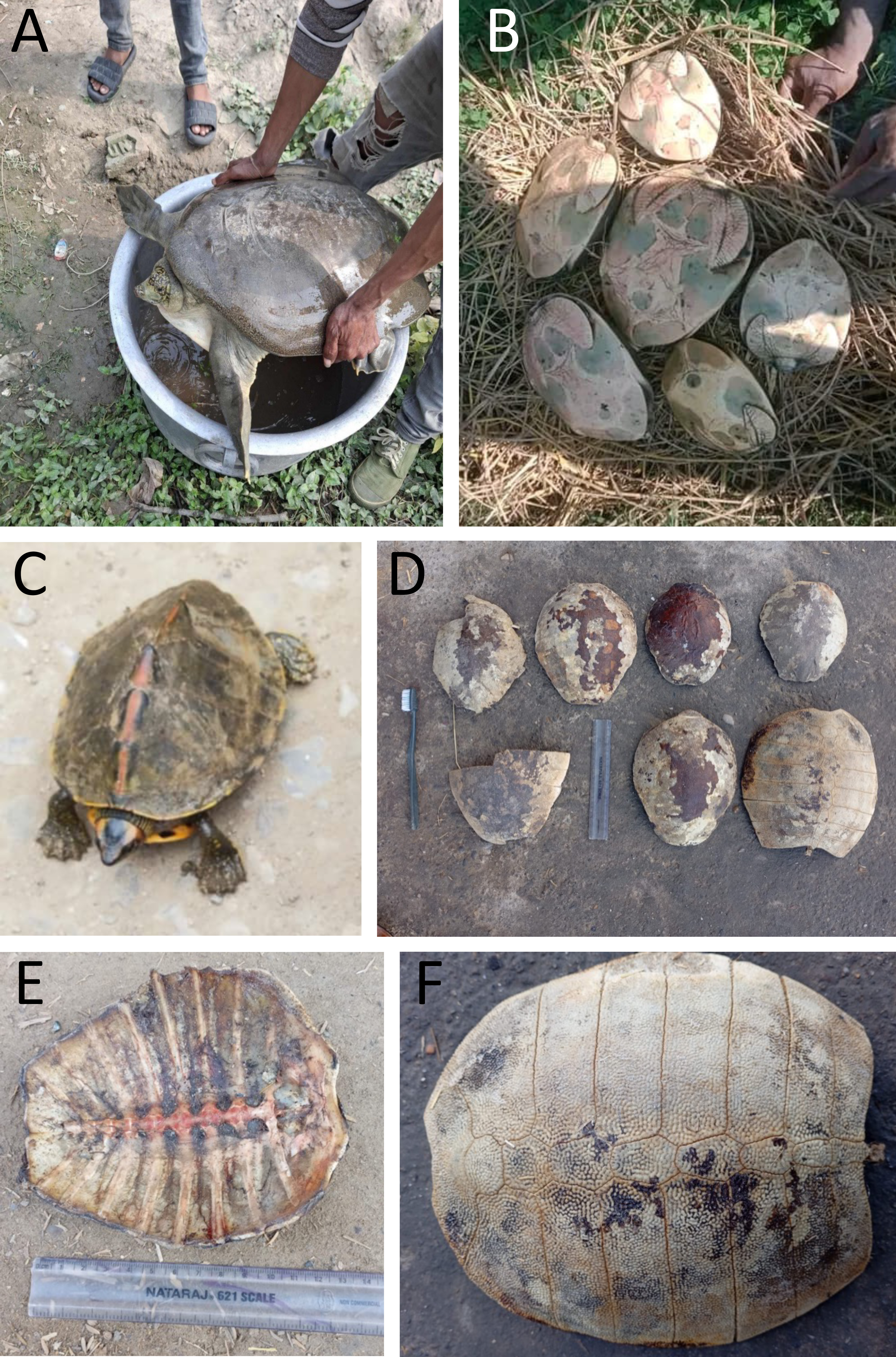
The Tharus are a prominent group of tribes who have lived in the Tarai belt of Nepal and India for centuries, relying on the forest for their survival. This ethnozoological study focuses on turtle collection and consumption by the Tharu community in the Rupandehi district of Nepal, discussing the distribution and abundance of turtle species and this community’s unique spearing method of turtle hunting. In this study, Tharu turtle hunters were hired to collect living specimens using the spearing method from nine locations, and interviews were conducted with local community members. Twenty-three living turtle specimens from three species were recorded, and an additional 81 shells were recovered from Tharu households. The Indian flapshell turtle (Lissemys punctata andersoni; Tharu: Gauriya Kachhuwa) was the most abundantly distributed species in the district. The survey of shells in households revealed that all specimens were Indian flapshell, while the two other specimens were Indian peacock softshell turtle (Nilssonia hurrum; Tharu: Supahawa kachhuwa) and Indian roofed turtle (Pangshura tecta; Tharu: Khapadahawa kachhuwa). During interviews all interlocutors described eating Gauriya kachhuwa and avoiding other land turtles for consumption. Spearing is used to hunt turtles, and it is utilized in marshes, ponds, and lakes. These reptiles are killed for their meat and for medicinal uses, and the community reports that a decline in the turtle populations has been observed near Tharu settlements. Therefore, we argue that an escalation of public awareness and policy advocacy is essential, particularly in rural areas where Tharu communities live, to ensure the survival of these reptiles in the face of mounting anthropogenic challenges.
References
Alves, R. 2012. Relationship between Fauna and People and the Role of Ethnozoology in Animal Conservation. Ethnobiology and Conservation 1:1–69. DOI:10.15451/ec2012-8-1.2-1-69.
Aryal, P. C., M. K. Dhamala, B. Prasad, M. K. Suwal, and B. Rijal. 2010a. Turtles of Nepal: A Field Guide for Species Accounts and Distribution. Environmental Graduates in Himalaya (EGH), and Companions for Amphibians and Reptiles of Nepal (CARON), Kathmandu, Nepal.
Aryal, P. C., M. K. Dhamala, B. Prasad, M. K. Suwal, and B. Rijal. 2010b. Species Accounts and Distribution of Turtles with Notes on Exploitation and Trade in Tarai, Nepal. In Proceedings of the First National Youth Conference on Environment (NYCE-I), pp. 29–38. Himalayan Alliance for Climate Change (HIMCCA), Kathmandu, Nepal.
Bhatta, O., B. P. Bhattarai, and K. Dumre. 2020. Diversity, Distribution, and Conservation Challenges of Turtles in Shuklaphanta National Park, Nepal. ARCO Nepal Newsletter 21:1–36.
Burke, R. 2021. Advances in the Biology and Conservation of Turtles. Diversity 13:17. DOI:10.3390/d13010017.
Chaubey, G., M. Singh, F. Crivellaro, R. Tamang, A. Nandan, K. Singh, V. K. Sharma, A. K. Pathak, A. M. Shah, V. Sharma, V. K. Singh, D. S. Rani, N. Rai, A. Kushniarevich, A. Ilumäe, M. Karmin, Anand Phillip, A. Verma, E. Prank, V. K. Singh, B. Li, P. Govindaraj, A. K. Chaubey, P. K. Dubey, A. G. Reddy, K. Premkumar, S. Vishnupriya, V. Pande, J. Parik, S. Rootsi, P. Endicott, M. Metspalu, M. Mirazon Lahr, G. van Driem, R. Villems, T. Kivisild, L. Singh, and K. Thangaraj. 2014. Unravelling the Distinct Strains of Tharu Ancestry. European Journal of Human Genetics 22:1404–1412. DOI:10.1038/ejhg.2014.36.
Chaudhary, B. R., G. Acciaioli, W. Erskine, and P. Chaudhary. 2021. Responses of the Tharu to Climate Change-related Hazards in the Water Sector: Indigenous Perceptions, Vulnerability and Adaptations in the Western Tarai of Nepal. Climate and Development 13:1–14. DOI:10.1080/17565529.2021.1889947.
Chaudhary, S. S. 2019. Cultural Framework for Studying a Tharu Community in Nepal. International Journal of Interdisciplinary and Multidisciplinary Studies (IJIMS) 6:73–83.
Crooke, W. 1907. Natives of Northern India. Archibald Constable and Company, London.
Desai, D. 2009. Kûrma Imagery in Indian Art and Culture. Artibus Asiae 69:317–333.
Division Forest Office Rupandehi. 2022. Introduction to Wetlands of Rupandehi District. Report published by Division forest Office Rupandehi on April 6, 2022, Lumbini Province Government, Ministry of Forest and Environment, Nepal.
Fornarino, S., M. Pala, V. Battaglia, R. Maranta, A. Achilli, G. Modiano, A. Torroni, O. Semino, and S. A. Santachiara-Benerecetti. 2009. Mitochondrial and Y-chromosome Diversity of the Tharus (Nepal): A Reservoir of Genetic Variation. BMC Evolutionary Biology 9:154. DOI:10.1186/1471-2148-9-154.
Fretey, J. 2001. Biogeography and Conservation of Marine Turtles of the Atlantic Coast of Africa. CMS Technical Series Publication 6, UNEP/CMS Secretariat, Bonn, Germany.
Fretey, J., G. H. Segniagbeto, and M. Soumah. 2007. Presence of Sea Turtles in Traditional Pharmacopoeia and Beliefs of West Africa. Marine Turtle Newsletter 116:23-25.
Graciá, E., R. C. Rodríguez-Caro, M. Ferrández, A. Martínez Silvestre, I. Perez-Ibarra, R. Amahjour, C. Aranda, H. A. Benelkadi, A. Bertolero, M. Biaggini, F. Botella, J. Bud, V. Cadenas, B. Chergui, C. Corti, F. Esperon, M. Angel Esteve-Selma, S. Fahd, M. I. G. de la Fuente, A. Golubovic, A. Heredia, M. V. Jimenez-Franco, M. Arakelyan, D. Marini, J. Martinez-Fernandez, M. C. Martinez-Pastor, R. Mascort, A. Mira-Jover, R. Pascual-Rico, A. Perera-Leg, B. Pfau, S. Pinya, X. Santos, A. Segura, M. J. Semaha, J. Soler-Massana, J. M. Vidal, and A. Gimenez. 2020. From Troubles to Solutions: Conservation of Mediterranean Tortoises under Global Change. Basic and Applied Herpetology 34:5–16. DOI:10.11160/bah.196.
Hand, W. D. 1980. Magical Medicine: The Folkloric Component of Medicine in the Folk Belief, Custom, and Ritual of the Peoples of Europe and America: Selected Essays of Wayland D. Hand. University of California Press, Berkeley.
KC, A., N. Wagle, and T. D. Acharya. 2021. Spatiotemporal Analysis of Land Cover and the Effects on Ecosystem Service Values in Rupandehi, Nepal, from 2005 to 2020. ISPRS International Journal of Geo-Information 10:635. DOI:10.3390/ijgi10100635.
Kharel, M. P. 2019. Reviewing the Anthropological Study of Tharus in Nepal. Tribhuvan University Journal 33:191–204. DOI:10.3126/tuj.v33i1.28694.
Lamsal, A. K., C. R. Dahal, and R. P. Pokhrel. 2022. Caste and Ethnic Area and Identity Politics in Nepal: An Anthropological Perspective. Journal of Social and Political Sciences 5:127–136. DOI:10.31014/aior.1991.05.01.341.
Lovich, J., J. Ennen, M. Agha, and J. Gibbons. 2018. Where Have All the Turtles Gone, and Why Does It Matter? BioScience 68:771–781. DOI:10.1093/biosci/biy095.
Martins, S. T., F. Rocha, E. Rodrigues, S. Lopes, N. Loureiro, and A. Marco. 2015. The Use of Sea Turtles in Traditional Medicine in the Cape Verde Archipelago, West Africa. African Sea Turtle Newsletter 4:12–15.
Muller-Boker, U. 1999. The Chitwan Tharus in Southern Nepal: An Ethnoecological Approach. Publications of The Nepal Research Centre 21:150.
National Population and Housing Census. 2021. National Report on Caste/Ethnicity, Language and Religion. National Statistics Office, Government of Nepal, Kathmandu, Nepal.
National Population and Housing Census. 2021. National Report on Caste/Ethnicity, Language and Religion. National Statistics Office, Government of Nepal.
Oki, M. 2022. The Enumeration of the manifestation and incarnation of Vishnu in Epic and Prana Literature. Journal of Indian and Buddhist Studies 70:1049–1052. DOI:10.4259/ibk.70.3_1049.
Patel, E., M. Kotera, and A. Phillott. 2022. The Roles of Sea Turtles in Ecosystem Processes and Services. Indian Ocean Turtle Newsletter 36:23–31.
Patyal, H. C. 1995. Tortoise in Mythology and Ritual. The East and the West 45:97–107.
Pun, S. K., C. B. Stanford, and B. B. Khadka. 2023. Distribution Records and Conservation Status of Turtles in Chitwan, Nepal. Journal of Institute of Science and Technology 28:25–30. DOI:10.3126/jist.v28i1.43364.
Rai, T. P. 2023. Pictorial Guide: Tortoises and Freshwater Turtles of Nepal and Their Conservation Status. Available at: https://tapilrai.blogspot.com/2019/05/tortoises-and-freshwater-turtles-of.html. Assessed on April 22, 2025.
Rhodin, A. G. J., J. B. Iverson, R. Bour, U. Fritz, A. Georges, H. B. Shaffer, and P. P. van Dijk. 2021. Turtles of the World: Annotated Checklist and Atlas Taxonomy, Synonymy, Distribution and Conservation Status, 9th edition. Chelonian Research Foundation and Turtle Conservancy, Arlington, Vermont, USA. DOI:10.3854/crm.8.checklist.atlas.v9.2021.
Santoro, A., J. M. Chambers, B. C. Ebner, A. L. Sturm, and S. J. Beatty. 2024. Long‐term Habitat Degradation Affects Nest Site Selection Behaviour by a Freshwater Turtle (Chelodina oblonga) in Western Australia. Aquatic Conservation: Marine and Freshwater Ecosystems 34:e4085. DOI:10.1002/aqc.4085.
Schoch, R. R., and H. D. Sues. 2019. The Origin of the Turtle Body Plan: Evidence from Fossils and Embryos. Palaeontology 63:375–393. DOI:10.1111/pala.12460.
Shah, K. B. and S. Tiwari. 2004. Herpetofauna of Nepal: a Conservation Companion. IUCN Nepal, Kathmandu, Nepal.
Singh, N. and D. K. Singh. 2015. Tharus and Their Enhancement in Modern Time of Lakhimpur-Kheri District, U.P. International Journal of Innovative Social Science and Humanity Research 2:18–24.
Stanford, C. B., J. B. Iverson, A. G. Rhodin, P. P. van Dijk, R. A. Mittermeier, G. Kuchling, K. H. Berry, A. Bertolero, K. A. Bjornda, T. E. G. Blanck, K. A. Buhlmann, R. L. Burke, J. D. Congdon, T. Diagne, T. Edwards, C. C. Eisemberg, J. R. Ennen, G. Forero-Medina, M. Frankel, U. Fritz, N. Gallego-García, A. Georges, J. W. Gibbons, S. Gong, E. V. Goode, H. T. Shi, H. Hoang, M. D. Hofmeyr, B. D. Horne, R. Hudson, J. O. Juvik, R. A. Kiester, P. Koval, M. Le, P. V. Lindeman, J. E. Lovich, L. Luiselli, T. E. M. McCormack, G. A. Meyer, V. P. Páez, K. Platt, S. G. Platt, P. C. H. Pritchard, H. R. Quinn, W. M. Roosenburg, J. A. Seminoff, H. B. Shaffer, R. Spencer, J. U. Van Dyke, R. C. Vogt, and A. D. Walde. 2020. Turtles and Tortoises Are in Trouble. Current Biology 30:R721–R735. DOI:10.1016/j.cub.2020.04.088.
Still, J. 2003. Use of Animal Products in Traditional Chinese Medicine: Environmental Impact and Health Hazards. Complementary Therapies in Medicine 11:118–122. DOI:10.1016/s0965-2299(03)00055-4.
The Wonder Nepal. 2025. How the Tharu People Use Traditional Traps for Hunting [web page]. Available at: https://thewondernepal.com/articles/how-the-tharu-people-use-traditional-traps-for-hunting/. Published on March 6, 2025.
Copyright (c) 2026 Manoj Kumar Tharu, Gyaneshwer Chaubey

This work is licensed under a Creative Commons Attribution-NonCommercial 4.0 International License.
Authors who publish with this journal agree to the following terms:
- Authors retain ownership of the copyright for their content and grant Ethnobiology Letters (the “Journal”) and the Society of Ethnobiology right of first publication. Authors and the Journal agree that Ethnobiology Letters will publish the article under the terms of the Creative Commons Attribution-NonCommercial 4.0 International Public License (CC BY-NC 4.0), which permits others to use, distribute, and reproduce the work non-commercially, provided the work's authorship and initial publication in this journal are properly cited.
- Authors are able to enter into separate, additional contractual arrangements for the non-exclusive distribution of the journal's published version of the work (e.g., post it to an institutional repository or publish it in a book), with an acknowledgement of its initial publication in this journal.
For any reuse or redistribution of a work, users must make clear the terms of the Creative Commons Attribution-NonCommercial 4.0 International Public License (CC BY-NC 4.0).
In publishing with Ethnobiology Letters corresponding authors certify that they are authorized by their co-authors to enter into these arrangements. They warrant, on behalf of themselves and their co-authors, that the content is original, has not been formally published, is not under consideration, and does not infringe any existing copyright or any other third party rights. They further warrant that the material contains no matter that is scandalous, obscene, libelous, or otherwise contrary to the law.
Corresponding authors will be given an opportunity to read and correct edited proofs, but if they fail to return such corrections by the date set by the editors, production and publication may proceed without the authors’ approval of the edited proofs.


