
Caspian Tigers and Loptuq Activity Contexts in Eastern Turkestan
Abstract
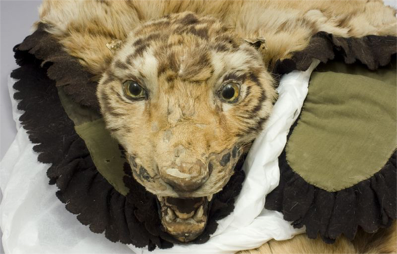
Until a hundred years ago, Caspian tigers (Panthera tigris tigris) shared habitat with the Loptuq people who lived along the Tarim River, and lake Lop Nur in Eastern Turkestan. Although their paths crossed, humans and tigers avoided each other and did not compete for resources; only occasionally did a tiger kill cattle and horses or humans kill a tiger. The tigers fed mainly on wild boar (Sus scrofa nigripes) while the Loptuq, for religious reasons, rejected it as food. Intensified contacts with the outside world at the end of the nineteenth century changed this situation. Tiger parts, for medicinal purposes, were in high demand among itinerant peddlers, and the state authorities required furs as tribute, causing some Loptuq men to hunt tigers on a larger scale. The Caspian tiger became extinct in the Tarim Basin, most likely in the 1920s, and during the following decades, it disappeared completely throughout its former range in Central Asia. In the mid-twentieth century, ecological and hydrological changes implemented by the Chinese government destroyed the unique fishing and gathering economy of the Loptuq, and the whole group was displaced and forcibly assimilated. Fragmented information about the activity contexts between the Loptuq and Caspian tigers exist now only in older sources and scholarly publications, which are reviewed here.
References
Abdukadir, A., and U. Breitenmoser 2007. The Last Tigers in Xinjiang. Cat News 47:26–27.
Balée, W. 1994. Footprints of the Forest: Ka’apor Ethnobotany. The Historical Ecology of Plant Utilization by an Amazonian People. Columbia University Press, New York.
Bang, W. 1917. Über die Türkischen Namen Einiger Großkatzen. Keleti Szemle 17:112–146.
Bellew, H. W. 1875. Kashmir and Kashgar. A Narrative of the Journey of the Embassy to Kashgar in 1873–74. Trübner and Co., London.
Büchner, E. 1894. Wissenschaftliche Resultate der von Przewalski nach Central-Asien Undernommenen Reisen Bd 1, Lief. 2. Säugetiere. Kaiserlichen Akademie der Wissenschaften, St. Petersburg, Russia.
Driscoll, C. A., N. Yamaguchi, G. K. Bar-Gal, A. L. Roca, S. Luo, D. W. Macdonald, and S. J. O’Brien. 2009. Mitochondrial Phylogeography Illuminates the Origin of the Extinct Caspian Tiger and Its Relationship to the Amur Tiger. PLoS ONE 4:e4125. DOI:10.1371/journal.pone.0004125.
Gao, Y. 2024. China’s Great West: Environment and Economy in Late Qing Xinjiang, 1877–1917. Unpublished Doctoral Dissertation, Department of History at Georgetown University, Georgetown, Washington DC.
Gordon, T. E. 1876. The Roof of the World. Being a Narrative of a Journey Over the High Plateau of Tibet to the Russian Frontier and the Oxus Sources on Pamir. Edmonston and Douglas, Edinburgh, Scotland.
Hällzon, P., Z. Ötkür, S. Ståhlberg, and I. Svanberg. 2024. Making the Most of Scarce Biological Resources in the Desert: Loptuq Material Culture in Eastern Turkestan around 1900. Journal of Ethnobiology and Ethnomedicine 20:25. DOI:10.1186/s13002-024-00660-5.
Hauenschild, I. 2003. Die Tierbezeichnungen bei Mahmud al-Kaschgari. Eine Untersuchung aus sprach- und Kulturhistorischer Sicht. Harrassowitz, Wiesbaden, Germany.
Hedin, S. 1898. Through Asia, vol. 2. Methuen, London.
Hedin, S. 1900. Die Geographisch-wissenschaftlichen Ergebnisse Meiner Reisen in Zentralasien, 1894–1897. Perth, Gotha, Germany.
Hedin, S. 1903. Central Asia and Tibet. Toward the Holy City of Lassa, vol. 1. Hurst and Blackett, London.
Hedin, S. 1904. Scientific Results of a Journey in Central Asia 1899–1902, vol. 1. The Tarim River. Lithographic Institute of the General Staff of the Swedish Army, Stockholm, Sweden.
Hedin, S. 1905. Scientific Results of a Journey in Central Asia 1899–1902, vol. 2. Lop Nor. Lithographic Institute of the General Staff of the Swedish Army, Stockholm, Sweden.
Hedin, S. 1911. Från pol till pol, vol. 1 [From Pole to Pole]. Bonniers, Stockholm, Sweden.
Hedin, S. 1925. My Life as an Explorer. Garden City Publishers, New York.
Hedin, S. 1940. The Wandering Lake. George Routledge and Son, London.
Heptner, V. G., and A. A. Studskii. 1992. Mammals of the Soviet Union, vol 2. Part 2 Carnivora (Hyenas and Cats). E. J. Brill, Leiden, Netherlands.
Jarring, G. 1946. Materials to the Knowledge of Eastern Turki: Tales, Poetry, Proverbs, Riddles, Ethnological and Historical Texts from the Southern Parts of Eastern Turkestan. 1. Texts from Khotan and Yarkand. Gleerup, Lund, Sweden.
Jarring, G. 1964. An Eastern Turki-English Dialect Dictionary. Gleerup, Lund, Sweden.
Jarring, G. 1979. Matters of Ethnological Interest in Swedish Missionary Reports from Southern Sinkiang. Gleerup, Lund, Sweden.
Jarring, G. 1997. Central Asian Turkic Place-Names. Lop Nor and Tarim Area. An Attempt at Classification Based on Sven Hedin’s Diaries and Published Works. The Sven Hedin Foundation, Stockholm, Sweden.
Jungius, H. 2010. Feasibility Study on the Possible Restoration of the Caspian Tiger in Central Asia. WWF, Russia. Available at: wwfeu.awsassets.panda.org/downloads/final_tigerreporthartm5_07_2010.pdf. Accessed on November 17, 2024.
Kitchener, A. C., C. Breitenmoser-Würsten, E. Eizirik, A. Gentry, L. Werdelin, A. Wilting, N. Yamaguchi, A. V. Abramov, P. Christiansen, C. Driscoll, W. Duckworth, W. Johnson, S. J. Luo, E. Meijaard, P. O’Donoghue, J. Sanderson, K. Seymour, M. Bruford, C. Groves, M. Hoffmann, K. Nowell, Z. Timmons, and S. Tobe. 2017. A Revised Taxonomy of Felidae. The Final Report of the Cat Classification Task Force of the IUCN Cat Specialist Group. Cat News, Special Issue 11:1–80.
Leche, W. 1904. Scientific Results of a Journey in Central Asia 1899–1902. Vol. 6, Part 1. Zoologie. Lithographic Institute of the General Staff of the Swedish Army, Stockholm, Sweden.
Le Coq, A. 1928a. Buried Treasures of Chinese Turkestan. An Account of the Activities and Adventures of the Second and Third German Turfan Expedition. George Allen and Unwin, London.
Le Coq, A. 1928b. Von Land und Leuten in Ost-Turkistan. Berichte und Abenteuer der 4. Deutschen Turfanexpedition. Verlag der J. C. Hinrichs'schen Buchhandlung, Leipzig, Germany.
Linacre, A., and S. S. Tobe. 2008. On the Trial of Tigers: Tracking Tiger in Traditional East Asian Medicine. Forensic Science International: Genetics Supplement Series 1:603–604. DOI:10.1016/j.fsigss.2007.10.112.
Malov, S. E. 1956. Лобнорский язык [Lobnor Language]. Изслательство АН Киргизской ССР, Фрунзе, Киргизской ССР. Kirghiz SSR Academy of Sciences, Frunze, Soviet Union.
Menges, K. H. 1933. Volkskundliche Texte aus Ost-Türkistan aus dem Nachlass von N. Th. Katanov. Verlag der Akademie der Wissenschaften, Berlin, Germany.
Myrdal, J. 2012. Source Pluralism and a Package of Methods. In Historical Knowledge: Quest of Theory, Method and Evidence, edited by S. Hellman and M. Rahikainen, pp. 155–189. Cambridge Scholars Publishing, Newcastle upon Tyne, UK.
Nazároff, P. S. 1935. Moved On! From Kashgar to Kashmir. George Allen and Unwin, London.
Peemot, V. S. 2024. The Horse in My Blood. Multispecies Kinship in the Altai and Saian Mountans. Berghahn, New York.
Pevcov, M. V. 1949. Путешествие в Кашгарийю и Кун-Лунь [Travels in Kashgaria and Kun-Lun]. Государственное Издатель’ство Географической литературы, Москва, Россия.
Przhevalsky, N. 1879. From Kulja, Across the Tian Shan to Lob-Nor. Simpson Low, Marston, Searle and Rivington, London.
Przhevalsky, N. M. 1888. От Кяхты на истоки Желтой реки: исследование Северной окраины Тибета и путь через Лоб-Нор по бассейну Тарима [From Kyakhta to the Headwaters of the Yellow River, Exploring the Northern Edge of Tibet, and Traveling through Lob-nor along the Tarim Basin]. В.С. Балашева, Санкт-Петербург, Россия.
Räsänen, M. 1969. Versuch eines etymologischen Wörterbuchs der Túrksprachen. Suomalais-Ugrilainen Seura, Helsinki, Finland.
Sanderson, E., D. Miquelle, A. Harihar, U. Breitenmoser, C. Breitenmoser-Würsten, D. Cooper, K. Faziolahi, K. Fisher, J. Goodrich, T. Gray, A. Kang, A. Kitchener, D. MacMillan, S. Ostrowski, L. Royte, K. Thapa, and N. Yamaguchi. 2025. The Indigenous Range of the Tiger (Panthera tigris). Diversity and Distributions 31:e13947. DOI:10.1111/ddi.13947.
Ståhlberg, S., and I. Svanberg. 2017. When is a Foraging Society? The Loplik in the Tarim Basin. In Hunter-Gatherers in a Changing World, edited by Aili Pyhälä and Victoria Reyes-García, pp. 21–39. Springer Press, New York.
Starostin, S., A. Dybo, and O. Mudrak. 2003. Etymological Dictionary of the Altaic Languages. (Handbuch der Orientalistik VIII:8). E. J. Brill, Leiden, Netherlands.
Sunquist, M., and F. Sunquist. 2002. Wild Cats of the World. University of Chicago Press, Chicago.
Svanberg, I., and S. Ståhlberg. 2020. Fisher-foragers Amidst the Reeds: Loptuq Perception of Waterscapes in the Lower Tarim Area. Ethnobiology Letters 11:128–136. DOI:10.14237/ebl.11.1.2020.1701.
Thevs, N. 2007. Ecology, Spatial Distribution, and Utilization of the Tugai Vegetation at the Middle Reaches of the Tarim, River Xinjiang, China. Cuvillier Verlag, Greifswald, Germany.
Törnquist, J. 1926. Kaschgar: Några Bilder från Innersta Asiens Land, Folk och Mission [Kashgar: Some Images from Inner Asia’s Countries, People and Mission]. Svenska Missionsförbundet, Stockholm, Sweden.
Trinkler, E. 1930. Im Land der Stürme. Mit Yak- und Kamelkarawanen durch Innerasien. Brockhaus, Leipzig, Germany.
Xinhua News Agency. One Million Yuan Reward for Xinjiang Tiger. Xinhua News Agency. Available at: www.china.org.cn/english/SO-e/25351.htm. Published on January 16, 2002.
Yamaguchi, N., C. A. Driscott, L. Werdelin, A. V. Abramov, G. Csorba, J. Cuisin, B. Fernholm, M. Hiermeier, D. Hills, L. Hunter H. Itakura, U. S. Johansson, V. Kascheev, K. Krohmann, T. Martin, M. Nowak-Kepmp, I. Y. Pavlinov, F. Renound, L. Tomsett, S. van der Mije, E. Zholnerovskaya, C. Groves, A. C. Kitchener, V. Nijman, and D. W. Macdonald. 2013. Locating Specimens of Extinct Tiger (Panthera tigris) Subspecies: Javan Tiger (P. T. sondaica), Balinese Tiger (P. T. balica), and Caspian Tiger (P. T. virgata), including Previously Unpublished Specimens. Mammal Study 38:187–198. DOI:10.3106/041.038.0307.
Yuan, Guoying 袁国映, 2010. “Zhuiyi Xinjiang hu 追忆新疆虎 [Reminiscences of the Xinjiang tiger].” Xinjiang huanjing baohu 新疆环境保护 32:14–17.
Copyright (c) 2026 Ingvar Svanberg, Patrick Hällzon, Urs Breitenmoser, Sabira Ståhlberg

This work is licensed under a Creative Commons Attribution-NonCommercial 4.0 International License.
Authors who publish with this journal agree to the following terms:
- Authors retain ownership of the copyright for their content and grant Ethnobiology Letters (the “Journal”) and the Society of Ethnobiology right of first publication. Authors and the Journal agree that Ethnobiology Letters will publish the article under the terms of the Creative Commons Attribution-NonCommercial 4.0 International Public License (CC BY-NC 4.0), which permits others to use, distribute, and reproduce the work non-commercially, provided the work's authorship and initial publication in this journal are properly cited.
- Authors are able to enter into separate, additional contractual arrangements for the non-exclusive distribution of the journal's published version of the work (e.g., post it to an institutional repository or publish it in a book), with an acknowledgement of its initial publication in this journal.
For any reuse or redistribution of a work, users must make clear the terms of the Creative Commons Attribution-NonCommercial 4.0 International Public License (CC BY-NC 4.0).
In publishing with Ethnobiology Letters corresponding authors certify that they are authorized by their co-authors to enter into these arrangements. They warrant, on behalf of themselves and their co-authors, that the content is original, has not been formally published, is not under consideration, and does not infringe any existing copyright or any other third party rights. They further warrant that the material contains no matter that is scandalous, obscene, libelous, or otherwise contrary to the law.
Corresponding authors will be given an opportunity to read and correct edited proofs, but if they fail to return such corrections by the date set by the editors, production and publication may proceed without the authors’ approval of the edited proofs.


